Global financial markets are navigating a complex web of uncertainty. Equity benchmarks across Asia have retreated, oil prices have surged sharply, and investors are recalibrating their strategies in response to shifting macroeconomic signals. Yet amid this turbulence, Bitcoin holds ground, displaying resilience that has captured the attention of traders, institutions, and policymakers alike.
The contrast is striking. While major indices in financial hubs like Tokyo, Shanghai, and Hong Kong have posted losses amid concerns over slowing growth and geopolitical tensions, the world’s largest cryptocurrency has managed to stabilize above key technical levels. At the same time, crude oil benchmarks such as Brent Crude and West Texas Intermediate have climbed on supply fears and rising demand expectations.
This divergence underscores a deeper transformation in how digital assets interact with traditional markets. Is Bitcoin evolving into a hedge against instability? Or is it simply benefiting from a rotation of capital as investors seek alternative stores of value? In this in-depth analysis, we explore why Bitcoin holds ground even as Asian markets retreat and oil surges, examining macroeconomic drivers, investor psychology, technical indicators, and the broader implications for the cryptocurrency market.
Asian Markets Retreat Amid Economic Headwinds
Slowing Growth and Policy Concerns
Asian equities have come under pressure due to a combination of slowing economic data, tightening financial conditions, and geopolitical uncertainty. Manufacturing activity in several export-driven economies has softened, while consumer demand remains uneven. Investors have responded by trimming exposure to risk assets, leading to broad-based declines across regional indices.
Central banks in Asia are also navigating difficult terrain. Efforts to balance inflation control with economic growth have created uncertainty around interest rate trajectories. When monetary policy tightens or appears unpredictable, equity markets often react negatively. This environment has contributed to the recent retreat in major Asian exchanges.
Currency Volatility and Capital Outflows
Another layer of complexity stems from currency fluctuations. A stronger U.S. dollar has pressured several Asian currencies, prompting capital outflows and increasing borrowing costs. When investors anticipate prolonged currency weakness, they often reduce exposure to local stocks.
In this context, the fact that Bitcoin holds ground becomes even more significant. Historically, Bitcoin has sometimes mirrored equity movements during risk-off periods. However, the current decoupling suggests a shift in market dynamics that warrants closer examination.
Oil Surges as Supply Risks Intensify
Energy Markets React to Geopolitical Tensions
Oil prices have surged amid renewed geopolitical tensions and concerns about supply disruptions. Rising energy costs ripple through global markets, influencing inflation expectations and central bank policy decisions.
The upward movement in oil benchmarks like Brent Crude and West Texas Intermediate reflects tightening supply conditions and resilient demand. For equity markets, higher oil prices often translate into higher input costs for businesses, compressing profit margins and weighing on stock valuations.
Inflation Expectations and Risk Sentiment
As oil surges, inflation expectations tend to rise. Higher inflation can prompt central banks to maintain or increase interest rates, which in turn pressures equities. Yet, interestingly, Bitcoin holds ground despite these inflationary signals.
Some analysts argue that this resilience is linked to Bitcoin’s perceived role as digital gold. While it remains more volatile than traditional safe-haven assets, its fixed supply and decentralized nature appeal to investors wary of currency debasement and persistent inflation.
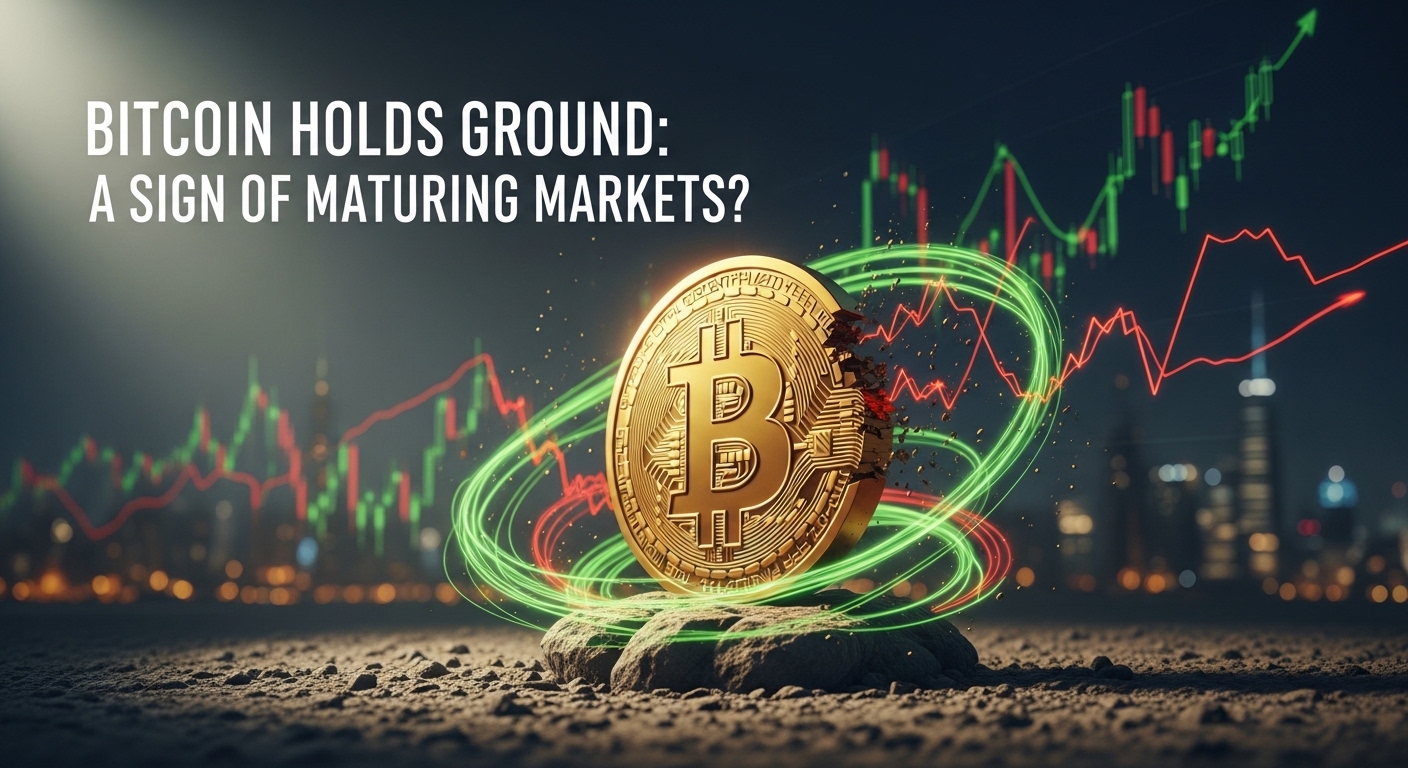
Bitcoin Holds Ground: A Sign of Maturing Markets?
Decoupling from Traditional Assets
In previous cycles, Bitcoin often traded in tandem with technology stocks, reflecting its classification as a high-risk asset. However, recent price action suggests a nuanced shift. While Asian markets retreat, Bitcoin’s relative stability indicates partial decoupling.
This phenomenon may be attributed to broader institutional participation. Asset managers and hedge funds increasingly view Bitcoin as part of a diversified portfolio rather than a speculative bet. The growth of regulated investment vehicles and improved custody solutions has strengthened market infrastructure, fostering greater confidence.
Technical Stability and Key Support Levels
From a technical perspective, Bitcoin holds ground near crucial support zones that traders closely monitor. Consolidation around these levels indicates balanced buying and selling pressure. When volatility remains contained despite negative macro headlines, it often signals underlying demand strength.
Market participants are observing moving averages, trading volume, and momentum indicators for confirmation of sustained stability. If Bitcoin maintains its current range, it could reinforce the narrative of resilience amid global uncertainty.
The Role of Institutional Investors
Increased Institutional Exposure
Institutional adoption has played a significant role in Bitcoin’s evolving market behavior. Large financial firms have gradually integrated digital assets into their offerings, providing exposure through funds, derivatives, and custody services. Companies such as BlackRock have entered the crypto space, lending credibility and attracting conservative investors who previously remained on the sidelines. This influx of institutional capital can dampen extreme volatility and provide a stabilizing force when traditional markets falter.
Portfolio Diversification Strategies
For institutional investors, diversification remains paramount. When Asian equities decline and oil surges, portfolio managers reassess asset allocations. Bitcoin’s non-sovereign nature and global liquidity make it an attractive hedge in certain macro scenarios.
While it does not yet function as a full-fledged safe haven, the fact that Bitcoin holds ground during regional equity sell-offs suggests it may be carving out a distinct niche in multi-asset portfolios.
Macroeconomic Forces Shaping Crypto Markets
Interest Rates and Liquidity Conditions
Global liquidity conditions significantly impact both equities and cryptocurrencies. Higher interest rates generally reduce appetite for speculative assets. Yet, despite tightening cycles in major economies, Bitcoin’s current resilience hints at evolving investor perceptions.
If central banks signal eventual rate cuts or policy pauses, liquidity could improve, potentially supporting both equities and digital assets. Until then, the ability of Bitcoin to remain steady underscores its growing depth and liquidity.
Geopolitical Uncertainty and Capital Flows
Geopolitical tensions often drive capital toward perceived safe assets. Gold has traditionally benefited from such shifts. However, younger investors increasingly view Bitcoin as a complementary hedge.
The narrative that Bitcoin holds ground while oil surges and Asian markets retreat may reinforce its appeal as a borderless asset less tied to regional economic performance.
Retail Participation and Market Psychology

Resilient Investor Sentiment
Retail investors remain an influential force in the cryptocurrency ecosystem. Despite negative headlines from global markets, on-chain data suggests steady accumulation rather than panic selling.
This behavior reflects growing confidence in Bitcoin’s long-term trajectory. Market participants appear to interpret external volatility as noise rather than a catalyst for capitulation.
Fear, Greed, and Market Cycles
Investor psychology oscillates between fear and greed. In periods when equities decline sharply, fear dominates traditional markets. Yet, in the crypto space, a measured response can signal maturity. The observation that Bitcoin holds ground amid broader financial stress points to a market less susceptible to knee-jerk reactions than in previous cycles.
Comparing Bitcoin to Traditional Safe Havens
Bitcoin vs. Gold
Gold has long been the benchmark safe haven during market turmoil. However, Bitcoin’s limited supply and transparent issuance schedule position it as a modern alternative. Although gold remains less volatile, Bitcoin’s ability to maintain price stability during Asian market weakness enhances its credibility as digital gold. Investors increasingly view the two assets as complementary rather than mutually exclusive.
Bitcoin vs. Equities
Equities are inherently tied to corporate earnings and economic growth. When growth slows or oil prices surge, stock valuations often decline. Bitcoin, by contrast, operates independently of corporate fundamentals.
The divergence between falling Asian stocks and a stable Bitcoin price underscores this distinction. It also strengthens the narrative that cryptocurrency markets may follow unique drivers.
Long-Term Implications for Global Finance
Evolution of Asset Correlations
Asset correlations shift over time. Bitcoin’s historical correlation with tech stocks may weaken as adoption broadens. A sustained pattern in which Bitcoin holds ground during equity downturns could reshape portfolio construction strategies worldwide.
Regulatory and Structural Developments
Regulatory clarity remains critical for long-term growth. As governments refine digital asset frameworks, institutional confidence may increase further. Improved transparency and compliance standards could enhance market stability. If regulatory progress continues alongside technological innovation, Bitcoin’s role in global finance may expand significantly.
Conclusion
The recent divergence between declining Asian markets, surging oil prices, and a steady Bitcoin price highlights a pivotal moment in financial history. While equities grapple with economic headwinds and energy costs climb, Bitcoin holds ground, signaling resilience and evolving market dynamics.
This stability does not imply immunity from volatility, but it suggests growing maturity within the cryptocurrency ecosystem. Institutional participation, diversification strategies, and shifting investor psychology all contribute to Bitcoin’s ability to withstand external shocks.
As global markets continue to navigate uncertainty, Bitcoin’s performance will remain closely watched. Whether it solidifies its reputation as digital gold or resumes correlation with risk assets depends on macroeconomic developments and investor sentiment. For now, the narrative is clear: even as Asian markets retreat and oil surges, Bitcoin holds ground, reinforcing its place in the evolving financial landscape.
FAQs
Q: Why does Bitcoin hold ground when Asian markets retreat?
Bitcoin operates independently of regional economic performance. Its decentralized nature and global liquidity allow it to maintain stability even when specific equity markets decline.
Q: How does rising oil impact Bitcoin prices?
Rising oil prices can increase inflation expectations and influence central bank policy. While this often pressures equities, Bitcoin’s fixed supply sometimes attracts investors seeking a hedge against inflation.
Q: Is Bitcoin becoming a safe-haven asset like gold?
Bitcoin is increasingly compared to gold due to its limited supply and decentralized structure. However, it remains more volatile and is still evolving as a potential safe haven.
Q: Do institutional investors affect Bitcoin’s stability?
Yes. Greater institutional participation can provide liquidity and reduce extreme price swings, helping Bitcoin remain stable during broader market volatility.
Q: What should investors watch next?
Investors should monitor macroeconomic indicators, central bank policies, oil price trends, and regulatory developments. These factors will shape whether Bitcoin continues to hold ground in uncertain markets.